
by Jane Copland
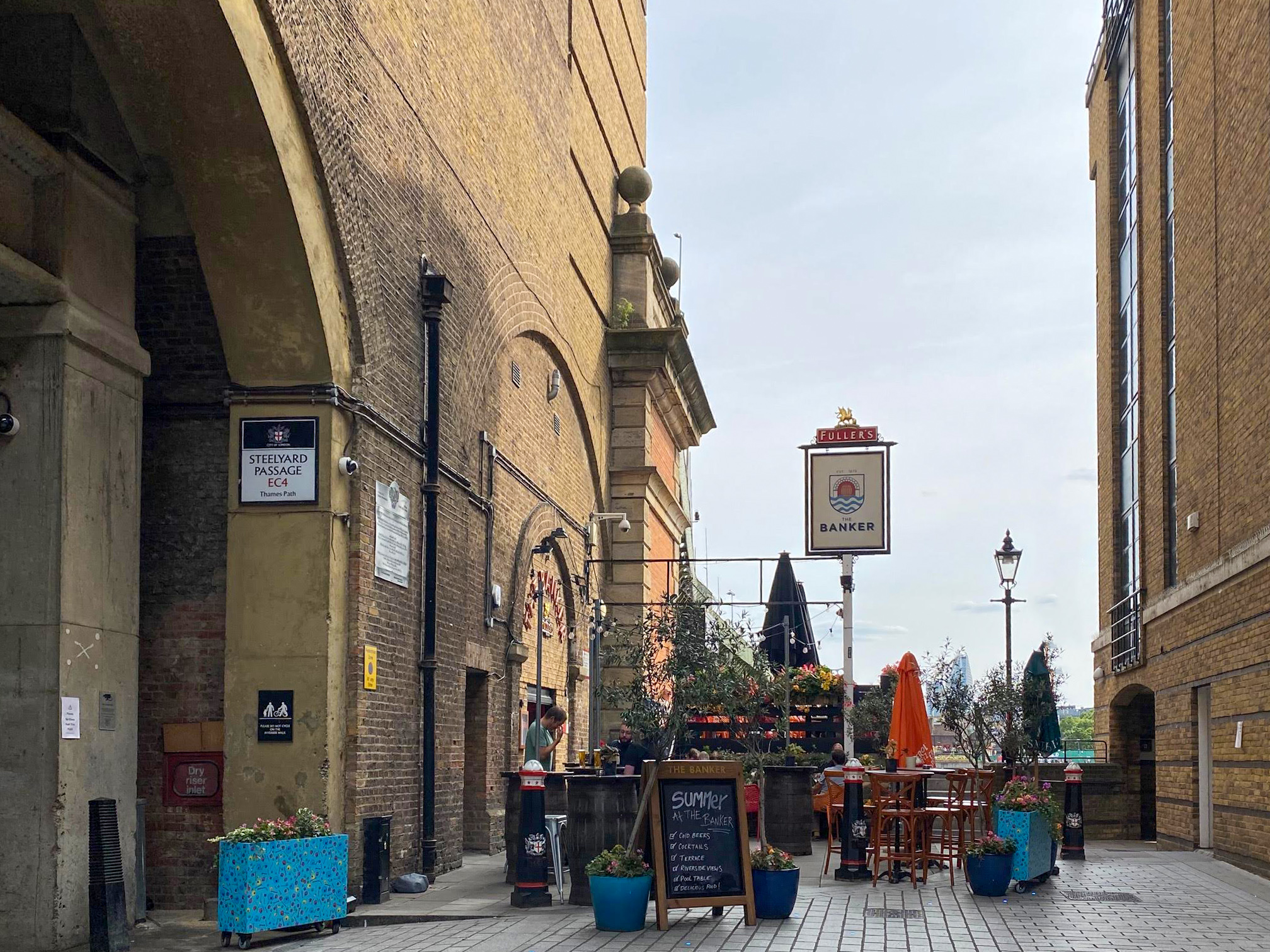 Imagine a little piece of medieval Germany in the heart of London. From
the 1200s to the 1600s, the mighty Hanseatic League – a confederation of
northern European trading cities – maintained its own walled enclave on
the Thames. This Steelyard was their main trading base in England.
Barges at its docks unloaded English wool and cloth, while Hanseatic
merchants imported spices, wax and timber. Behind high walls they built
warehouses, a weigh-house, a chapel and even their own guildhall –
almost like a tiny fortified town within London.
Origins of the Steelyard
In the late 1100s, King Henry II invited merchants from Cologne to settle in
London, granting them a riverside warehouse and broad trading privileges.
This “Germans’ Guildhall” on Thames Street was meant to strengthen
English trade against Flemish rivals. (The name Steelyard actually comes
from the German Stâlhof, meaning “sample yard” for inspecting wool.)
Throughout the 1200s, more merchants from Lübeck, Hamburg and other
Hanseatic towns arrived. By 1303 King Edward I’s merchant charter
officially confirmed the Hanseatic League’s rights and tax exemptions in
England.
A Walled Community on the Thames
The Steelyard’s layout spanned some 1.3 acres (bounded by modern
Cousin Lane and Thames Street). The site was fully walled, with docks and
warehouses lining the river. Inside stood a cloth hall, weigh-house, wine-
cellars, kitchens and a small chapel. The German merchants even built a
guildhall and ran their own courts – essentially operating a mini-city under
Hanseatic law.
Privileges, Trade, and Power
Hanseatic merchants thrived on the English wool and cloth trade and on
importing luxury goods. In return, they enjoyed generous exemptions from
customs duties. To prove their loyalty, the League even paid to rebuild
Bishopsgate (one of London’s city gates on their trade routes) so their
caravans could move freely. In 1503 Parliament passed a Hanse
Merchants Act formally confirming these exemptions. By that time the
Steelyard had its own treasury, seal and courts – effectively a German-run
enclave in London.
Friction and Decline
Tensions eventually boiled over. In 1468 King Edward IV arrested
Hanseatic merchants in London after Hanseatic ships attacked English
traders. Peace treaties (like Utrecht in 1474) often restored their rights, but
by the 1500s English merchants were chafing at Hanseatic privileges. The
Tudor monarchs cut those privileges: customs exemptions were suspended
in 1552 and finally revoked by Elizabeth I in 1598. (James I briefly
reopened the Steelyard, but it never regained its former power.)
The Great Fire of London in 1666 then destroyed most of the Steelyard’s
buildings. The land remained Hanseatic property until 1852, when Lübeck,
Bremen and Hamburg sold it to build Cannon Street railway station.
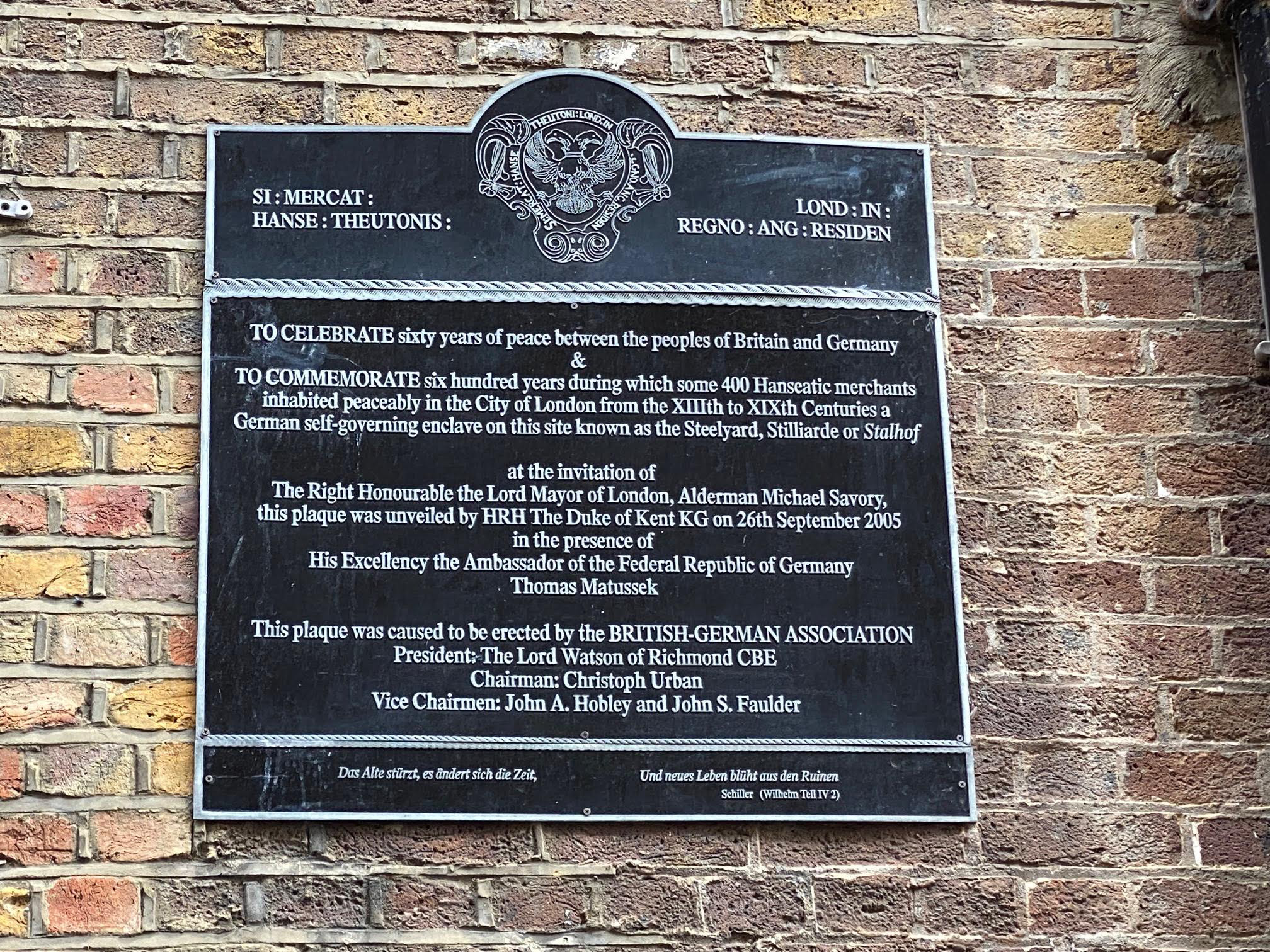
Almost nothing of the Steelyard remains visible today. In 1988, construction
under Cannon Street station uncovered fragments of the old riverside wall.
Otherwise, the legacy survives only in street names: Steelyard Passage (a
tunnel under the railway) and Hanseatic Walk. A small plaque at Cannon
Street commemorates the old trading post.
A 17th-century stone relief (by Caius Gabriel Cibber) shows the League’s
emblem – a double-headed eagle flanked by lions- and is one of the few
surviving artifacts of the Steelyard (now with the Museum of London).
Standing in Steelyard Passage today, it’s easy to forget that this humble
tunnel once led into a bustling enclave of medieval global trade.