
Temple Bar: London’s Ceremonial Gateway
by Jane Copland
Setting the Scene on Fleet Street
Stand on Fleet Street near the boundary between the City of London and Westminster and you’ll notice a striking stone griffin perched high on a pedestal. Wings raised, claws tense, it looks as though it is guarding the ancient heart of the capital. Many Londoners pass it daily without realising they are standing at one of the most historically charged gateways in the city: the site of Temple Bar.
The current monument is not the original Temple Bar itself, but a Victorian memorial marker erected in the 1880s after the old gateway was removed. The fierce dragon-like creature — technically a griffin, though often called a dragon — marks the ceremonial entrance to the City of London. Cross this invisible threshold and you enter a place with its own Lord Mayor, traditions, and centuries of fiercely defended independence.
Temple Bar was once one of the great gateways into the City. It stood as both a physical barrier and a symbolic frontier between royal authority and the self-governing power of the City of London. Few structures captured the tension, pageantry, and politics of old London so perfectly.
Why the “Bars” Existed
In medieval London, “bars” were gateways or checkpoints placed at important entrances to the City. They controlled trade, taxation, and movement, while also offering protection during periods of unrest. The City of London was enclosed by defensive walls and approached through gates and barriers that could be shut if danger threatened.
Temple Bar took its name from the nearby Temple Church and the lands once occupied by the Knights Templar. The route along Fleet Street was one of the principal roads linking the royal centre at Westminster with the mercantile power of the City.
By the Middle Ages, Temple Bar had become much more than a toll point. It evolved into a ceremonial entrance where monarchs paused before entering the City. Tradition demanded that the sovereign request permission to proceed. The Lord Mayor would present the City Sword as a gesture of loyalty, after which the monarch would symbolically return authority. The ritual reinforced an important constitutional truth: the City of London possessed rights and privileges independent of the Crown.
Temple Bar also had a darker side. During the Tudor and Stuart eras, traitors’ heads were sometimes displayed on spikes above the gate as a warning to dissenters. After the executions connected to plots against the monarchy, grim reminders of state power looked down upon everyone travelling along Fleet Street. Samuel Pepys recorded seeing such displays in the seventeenth century.
So Temple Bar was never merely decorative. It was theatre, politics, security, and intimidation all at once.
From Timber Barrier to Wren’s Monument
The earliest Temple Bar was probably a simple chain or wooden barrier across the roadway. Over time it became more elaborate, but the structure suffered repeated damage from fire, weather, and London’s endlessly increasing traffic.
Then came the catastrophe that transformed the city forever: the Great Fire of London.
After the fire devastated huge areas of London in 1666, rebuilding began on an unprecedented scale. One of the leading figures in this transformation was Sir Christopher Wren, whose work would reshape the skyline of the capital. Wren is most famous for St Paul’s Cathedral, but he also designed dozens of churches and several important civic structures.
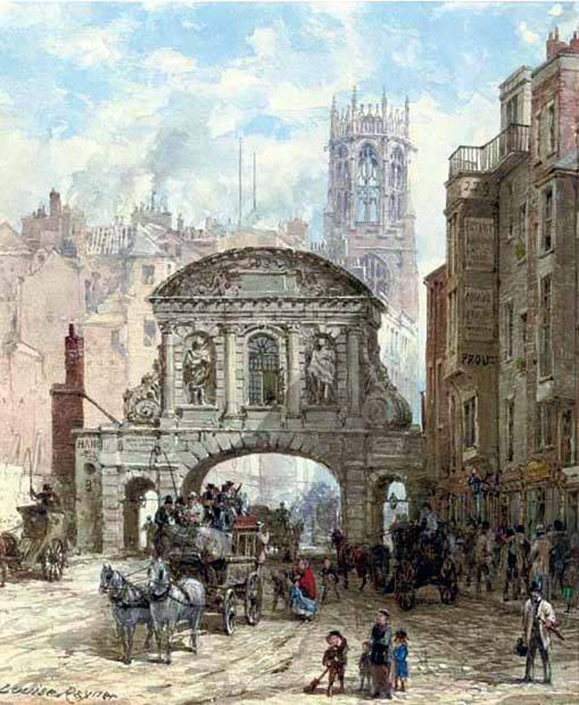
In the 1670s, Wren was commissioned to create a grand new Temple Bar in stone. Completed around 1672, it became the only ceremonial gateway to the City of London built in the classical style.
The new structure was both elegant and imposing. Constructed from Portland stone, it featured central and side arches allowing traffic to pass beneath. Above the arches stood statues of monarchs including King Charles I and King Charles II, symbolically linking royal authority with the restored order of post-fire London.
Unlike medieval gates designed primarily for defence, Wren’s Temple Bar was about prestige and ceremony. London was becoming a modern commercial capital, and the gateway reflected confidence, wealth, and grandeur.
For nearly two centuries, the structure dominated the western approach to the City. Coaches rattled beneath it, newspaper boys shouted headlines nearby on Fleet Street, and generations of Londoners passed through its arches.
A Victim of Victorian Traffic
By the nineteenth century, however, London had changed dramatically. The population exploded, commerce intensified, and the streets became clogged with traffic. Temple Bar – once so impressive – increasingly appeared to Victorian planners as an obstruction.
In 1878 the decision was made to dismantle it.
The removal caused considerable public debate. Many feared an architectural treasure would be destroyed. Fortunately, instead of being demolished, the stones were carefully numbered and preserved.
The gateway was purchased by brewer and parliamentarian Sir Henry Meux, who transported it to his estate at Theobalds Park in Hertfordshire. There, astonishingly, Wren’s great London gateway stood for over a century, isolated from the bustling city it had once guarded.
Meanwhile, the griffin monument was erected near the original site on Fleet Street to preserve the symbolic boundary marker between the City and Westminster. Today, many people mistakenly assume the griffin itself is Temple Bar.
The Journey Home
The story might have ended there — a displaced monument slowly fading into obscurity in the countryside — but the late twentieth century brought renewed interest in restoring London’s architectural heritage.
In the 1970s and 1980s, campaigns gathered momentum to bring Temple Bar back to the City. Eventually, the City of London secured the structure and began an ambitious restoration project.
Stone by stone, Wren’s gateway was dismantled again and transported back to London.
A new site was chosen beside St Paul’s Cathedral at Paternoster Square, close to the cathedral that had also emerged from Wren’s rebuilding of the city after the Great Fire. The location created a fitting historical reunion between two of Wren’s surviving masterpieces.
In 2004, Temple Bar officially reopened to the public.
Today, standing beside St Paul’s, the gateway feels both familiar and strangely unexpected. Removed from the roar of Fleet Street traffic, its architectural details can finally be appreciated properly: the carved stonework, classical proportions, and statues that once watched over one of the busiest roads in Britain.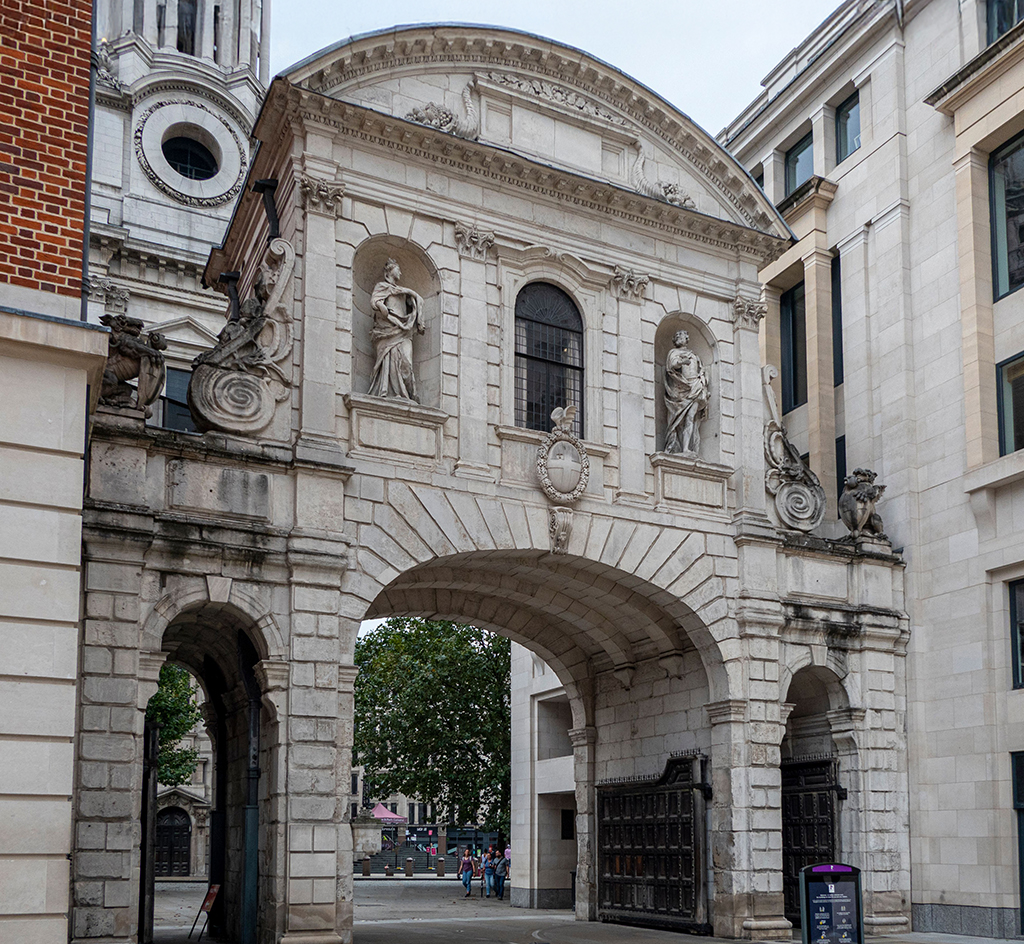
More Than a Gateway
Temple Bar’s story mirrors the story of London itself and represents the enduring independence of the City of London, the ceremonial relationship between Crown and commerce, and the remarkable survival of historic architecture in a city constantly reshaping itself.
Most of all, Temple Bar reminds us that London’s streets are layered with forgotten meanings. A modern commuter walking past the griffin on Fleet Street may see only traffic and office buildings. Yet beneath the noise lies the memory of kings entering the City, crowds gathering beneath Wren’s arches, and centuries of Londoners crossing a threshold that once marked the edge of one of the world’s most powerful cities.